

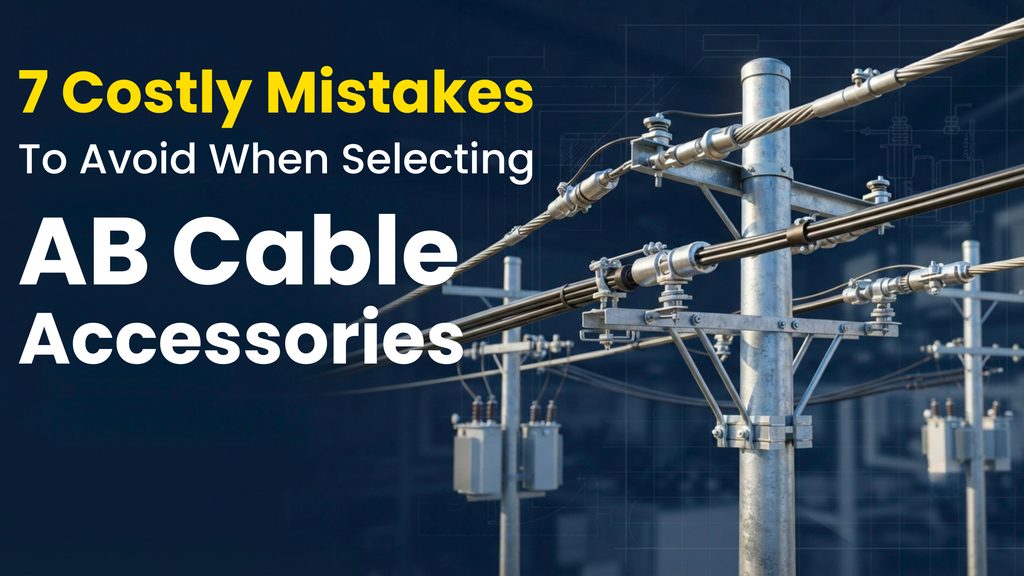
Selecting the right AB cable accessories may seem like a straightforward procurement decision. For utility companies, EPC contractors, electrical contractors, distributors and infrastructure project managers, however, the wrong component can lead to installation problems, compatibility issues, premature failures and unexpected project costs.
AB cable systems depend on accessories such as suspension clamps, dead-end clamps, insulation piercing connectors, brackets, eye hooks and other fittings to maintain mechanical support and reliable electrical connections. Choosing these components only on the basis of price can create problems long after the purchase order has been completed.
If you are responsible for sourcing AB cable accessories, here are seven costly mistakes you should avoid.
1. Choosing AB Cable Accessories Only on the Basis of Price
Price is important in B2B procurement—but it should not be the only deciding factor.
A lower-priced accessory may appear attractive during quotation comparison, but if its material quality, mechanical performance or dimensional consistency is inadequate, the project can face higher installation and maintenance costs.
For large infrastructure projects, procurement teams should evaluate the total cost of ownership rather than simply comparing the price per piece.
Before selecting a supplier, consider:
- Material quality
- Mechanical strength
- Electrical performance
- Environmental resistance
- Product consistency
- Testing and inspection
- Installation requirements
- Expected service life
The objective should be cost efficiency, not simply the lowest purchase price.
2. Ignoring Cable Size and Application
One of the most common procurement mistakes is selecting an accessory without carefully checking the cable configuration.
Suspension clamps, dead-end clamps and connectors are designed for specific cable sizes and applications. An accessory that is suitable for one AB cable configuration may not be suitable for another.
Before placing a bulk order, verify:
- Cable size
- Cable construction
- Messenger configuration
- Main conductor size
- Tap conductor size
- Suspension or anchoring application
- Installation arrangement
- Required mechanical load
This is particularly important for EPC and utility projects where thousands of components may be installed across multiple locations.
A simple dimensional mismatch at the procurement stage can become a significant field problem later.
3. Selecting an AB Cable Accessories Manufacturer Without Checking Technical Capability
Not every supplier offering AB cable accessories has the same manufacturing capability.
For B2B buyers, selecting an AB cable accessories manufacturer should involve more than comparing quotations. Procurement and engineering teams should evaluate whether the manufacturer can consistently produce components according to the required specifications.
Ask the manufacturer for relevant documentation such as:
- Product datasheets
- Technical specifications
- Material details
- Test reports
- Quality certificates
- Applicable standards
- Product samples
- Inspection documentation
A technically capable manufacturer should also be able to discuss your cable configuration, project requirements and installation conditions with your engineering team.
This becomes especially important when purchasing accessories for large utility, EPC or infrastructure projects.
4. Overlooking Material Quality and Outdoor Conditions
AB cable accessories are generally used in outdoor electrical distribution systems, where components can be exposed to sunlight, rain, humidity, temperature changes, mechanical loading and other environmental conditions.
Material selection therefore matters.
Polymer components should have appropriate environmental resistance, while metallic components should provide suitable corrosion resistance and mechanical strength for their intended application.
When evaluating a product, don’t simply ask:
“What material is it made from?”
Also ask:
“Is this material suitable for the actual operating environment and application?”
This distinction is particularly important when accessories are expected to remain installed for many years with minimal maintenance.
5. Treating Insulation Piercing Connectors Like Ordinary Hardware
Insulation Piercing Connectors, commonly known as IPCs, are critical components in AB cable distribution systems.
They are used to establish electrical connections without removing the conductor insulation in the conventional manner. Because IPCs directly influence electrical connectivity, choosing one simply because it physically fits the cable can be a costly mistake.
Procurement teams should verify:
- Main conductor size
- Tap conductor size
- Conductor material
- Insulation compatibility
- Electrical requirements
- Connector configuration
- Tightening mechanism
- Applicable project specifications
For utility and EPC projects, IPC selection should be treated as a technical decision rather than an ordinary hardware purchase.
6. Buying Individual Components Without Planning the Complete HT / LT Line Material
Another common mistake occurs when procurement teams purchase individual accessories without considering the complete overhead distribution requirement.
An AB cable installation may require multiple components, including:
- Suspension clamps
- Dead-end or anchoring clamps
- Insulation piercing connectors
- Eye hooks
- Pole brackets
- Stainless-steel straps
- Buckles
- Other line hardware
When these components are sourced from multiple suppliers without adequate coordination, problems can arise in compatibility, documentation, quality consistency and delivery schedules.
For larger projects, it can be more efficient to evaluate the complete HT / LT line material requirement at the planning stage.
This gives procurement teams a clearer view of quantities, specifications, delivery schedules and supplier responsibilities.
7. Choosing an AB Cable Accessories Manufacturer in Delhi Without Evaluating Support
Location can be useful when selecting a supplier, particularly when your project requires frequent communication, inspections, samples or faster coordination.
However, simply searching for an AB cable accessories manufacturer in Delhi is not enough.
Before finalizing a supplier, evaluate:
- Manufacturing capability
- Production capacity
- Quality-control process
- Technical support
- Sample approval process
- Inspection support
- Documentation
- Delivery capability
- Customization capability
- Response to technical queries
For B2B procurement, supplier support can become just as important as the product itself.
A manufacturer that can support your engineering, procurement and quality teams throughout the project can make the entire purchasing process more manageable.
How to Select the Right AB Cable Accessories Supplier:
A structured supplier evaluation can help reduce procurement risks.
Before placing your purchase order, ask five basic questions:
1. Is the accessory compatible with our cable?
Check cable size, configuration and application.
2. Is the material suitable for the installation environment?
Consider outdoor exposure, mechanical loading and corrosion requirements.
3. Can the manufacturer provide technical documentation?
Review datasheets, specifications, test reports and relevant certificates.
4. Can the supplier maintain consistent quality in bulk quantities?
A sample may look acceptable, but large projects require batch-to-batch consistency.
5. Can the manufacturer provide technical support when required?
This can be important during inspection, installation and commissioning.
Final Thoughts
AB cable accessories may be smaller than the cable, pole or transformer used in an electrical distribution project, but their role should not be underestimated.
Suspension clamps, dead-end clamps, IPCs, brackets and other accessories must work together as part of the overall distribution system. Selecting them purely on price—or without checking compatibility, material quality and manufacturing capability—can create avoidable project risks.
For utilities, EPC companies, electrical contractors and distributors, the better approach is to evaluate technical suitability, quality, consistency, documentation and supplier capability alongside price.
The right procurement decision is not simply about buying an accessory.
It is about selecting a component that is appropriate for the cable, application, installation environment and project requirements.
Before your next AB cable procurement, check the specification first—and the quotation second.