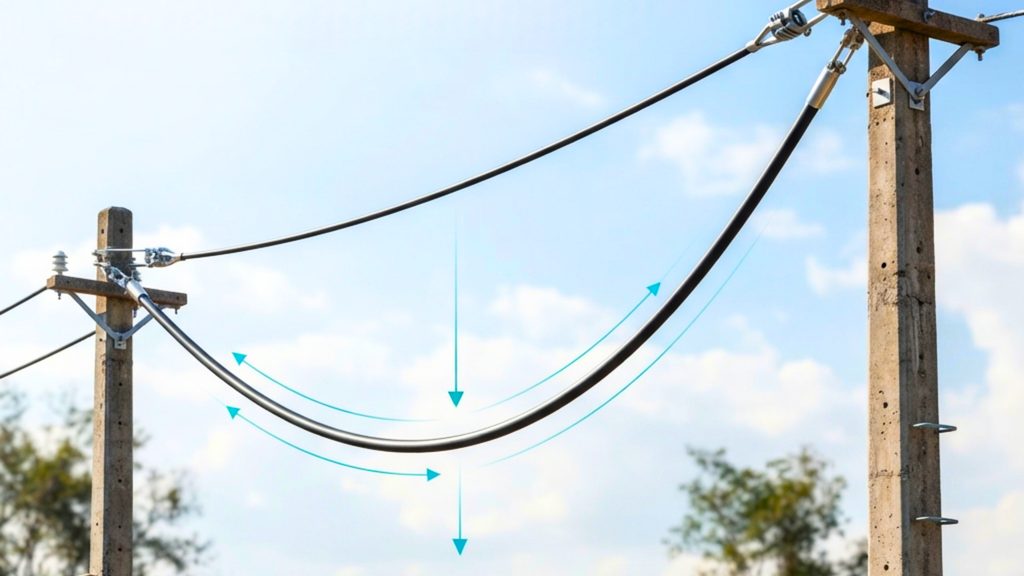

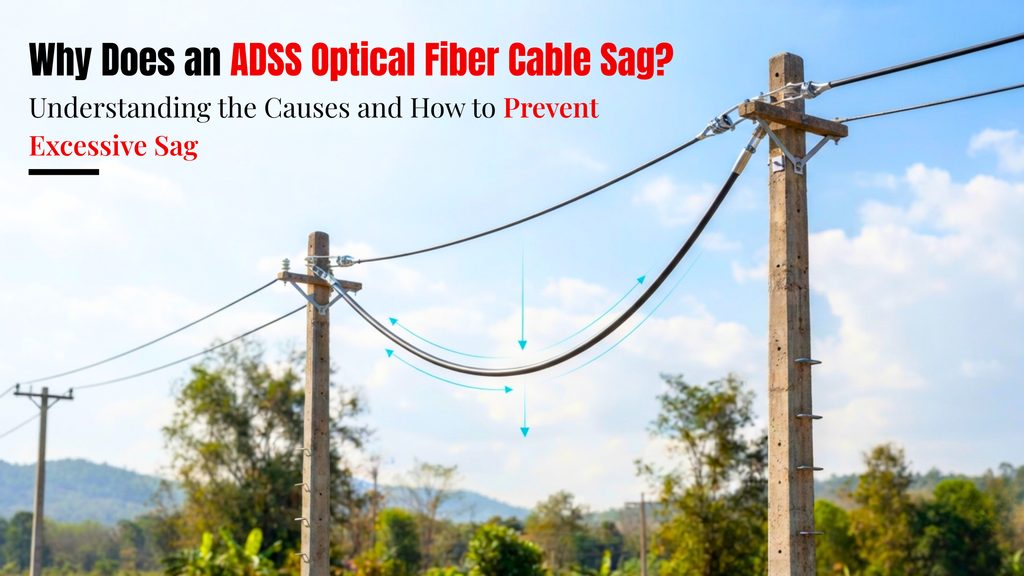
ADSS (All-Dielectric Self-Supporting) cable is widely used in overhead telecom networks because it can be installed on utility poles without a metallic messenger wire. However, like any aerial cable, an ADSS cable naturally develops some sag between two support points. The concern begins when the sag becomes excessive or changes significantly over time.
Excessive sag can reduce ground clearance, affect the cable’s mechanical performance, and create problems during operation and maintenance. Understanding why an ADSS cable sags is therefore important for telecom contractors, EPC companies, utilities, and procurement teams selecting ADSS cable accessories.
1. Cable Span and Installation Tension
One of the most important factors affecting ADSS cable sag is the distance between two supporting poles.
As the span length increases, the cable has to support its own weight over a longer distance. This naturally increases sag if the installation tension and design conditions are not appropriate.
During installation, the cable should be tensioned according to the manufacturer’s specifications and the project design. Excessive tension should also be avoided because over-tensioning can place unnecessary mechanical stress on the cable.
For this reason, span length, cable construction, installation tension, and environmental conditions should be considered together when planning an overhead ADSS network.
2. Cable Weight and Construction
The weight and construction of the ADSS cable directly influence its sag characteristics.
A heavier cable places greater load on the supporting system. Cable diameter, fiber count, strength members, sheath construction, and overall cable design can all influence the mechanical behavior of the cable.
Before selecting ADSS cable fittings, project teams should therefore verify the cable’s actual diameter, weight, rated mechanical characteristics, and installation requirements.
Using accessories without considering the cable’s specifications can create installation and long-term performance problems.
3. Wind, Ice and Temperature Changes
ADSS cables are installed outdoors and are exposed to changing environmental conditions.
Strong wind can create additional lateral loading on the cable. In areas where ice accumulation occurs, additional weight can also increase mechanical loading.
Temperature is another important factor. The cable and its components can experience changes in mechanical behavior as temperature changes. This can cause variations in sag between different operating conditions.
Therefore, ADSS network design should consider the environmental conditions expected at the installation location rather than relying only on the cable’s unloaded condition.
4. Incorrect or Poorly Selected ADSS Accessories
The supporting hardware plays an important role in maintaining the cable’s position.
An ADSS suspension clamp is generally used at intermediate support points to support the cable while allowing the required movement and maintaining the cable’s intended position.
At termination or dead-end locations, an ADSS anchor clamp is used to secure the cable and transfer the required mechanical load to the supporting structure.
Similarly, an ADSS pole bracket provides the necessary connection between the cable accessory and the pole.
If the wrong accessory is selected for the cable diameter, span, installation condition, or mechanical requirement, the cable may not be properly supported. Over time, this can contribute to undesirable cable movement or excessive sag.
5. Improper Installation
Even good-quality accessories cannot compensate for incorrect installation.
Incorrect installation tension, improper positioning of clamps, insufficient tightening, incorrect cable routing, or failure to follow the manufacturer’s installation instructions can affect the cable’s mechanical performance.
Installation teams should verify cable dimensions before fitting the hardware and ensure that each accessory is installed according to its intended application.
The suspension and anchoring points should also be checked after installation to ensure that the cable is properly supported throughout the route.
6. Pole Movement and Supporting Structure Conditions
Sometimes the cause of increased sag is not the cable itself.
Pole deflection, movement, damaged brackets, loose hardware, or changes in the supporting structure can alter the distance or geometry between support points.
For this reason, inspection of an ADSS route should include both the cable and its supporting infrastructure.
A telecom contractor or maintenance team should check the condition of the poles, brackets, clamps, and other ADSS cable fittings when investigating unexpected sag.
7. How Can Excessive ADSS Cable Sag Be Prevented?
Preventing excessive sag starts with proper network planning and correct accessory selection.
Before installation, project teams should evaluate:
- Cable diameter and weight
- Pole-to-pole span
- Required installation tension
- Environmental loading
- Cable route and pole configuration
- Suitable suspension and anchoring points
- Compatibility of the selected accessories
Working with an experienced ADSS accessories manufacturer can also help project teams identify suitable hardware for different cable sizes and installation conditions.
A reliable telecom accessories manufacturer should be able to provide technically appropriate products and specifications rather than treating every installation as the same.
Choosing the Right ADSS Cable Accessories
A properly designed ADSS network requires more than simply selecting a suitable fiber optic cable. The supporting hardware must also match the cable and installation conditions.
Products such as ADSS suspension clamp, ADSS anchor clamp, and ADSS pole bracket each have specific applications within an overhead network. Selecting the correct accessory for the cable diameter and support location helps maintain the intended cable geometry and mechanical performance.
For projects requiring reliable ADSS accessories, working with an experienced supplier can simplify product selection and procurement.
Modern Sanitations manufactures ADSS cable fittings and telecom accessories for overhead network applications. As an ADSS accessories manufacturer in Delhi NCR, the company supplies accessories designed for different cable sizes and installation requirements.
Final Thoughts
Some amount of sag is normal in an aerial ADSS cable installation. However, excessive sag can result from long spans, cable weight, environmental loading, incorrect installation, unsuitable accessories, or movement of the supporting structure.
The solution is not simply to increase cable tension. Proper engineering, suitable installation practices, regular inspection, and correctly selected ADSS cable accessories are all important for maintaining a reliable overhead telecom network.
For telecom contractors, EPC companies, utilities, and distributors, choosing the right ADSS accessories manufacturer and verifying accessory compatibility before installation can help reduce installation problems and support long-term network performance.