

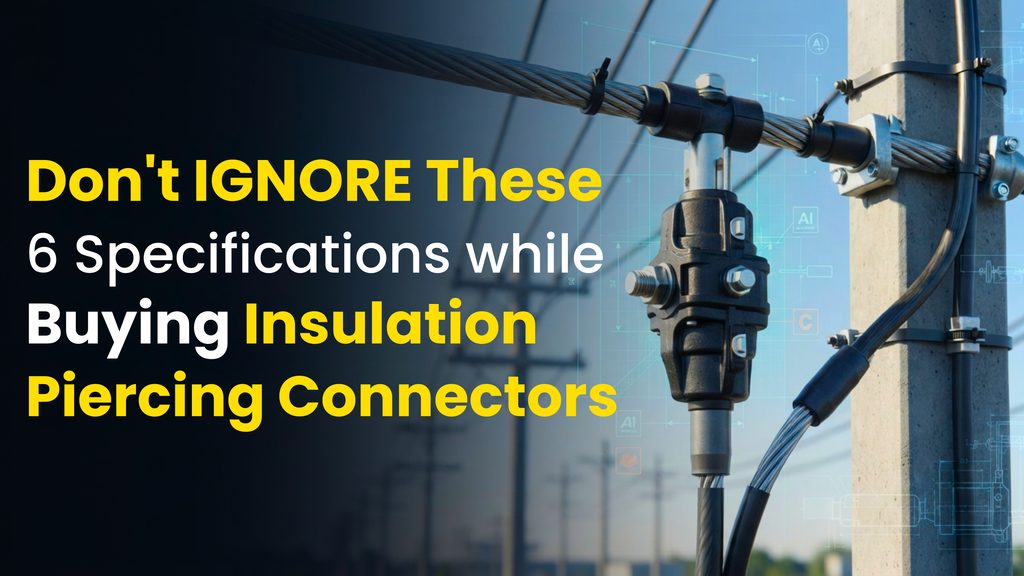
An Insulation Piercing Connector (IPC) might seem like a small component in the overall scheme of an AB cable, pole or distribution system. But within an overhead, low-voltage distribution network, that small component plays an important role in establishing an electrical connection between insulated conductors while preserving the required insulation and mechanical integrity.
For utilities, EPC contractors, electrical contractors, distributors and procurement teams, selecting an IPC should therefore never be based simply on price and appearance.
IPC products are designed for different main and tap conductor ranges, insulation thicknesses, electrical ratings and installation requirements and manufacturer specifications can vary significantly between different models.
Before you place your next order for bulk AB accessories, check these seven specifications.
1. Main and Tap Cable Size
This is the first spec your procurement team should verify.
An IPC must be compatible with both the main conductor and the tap conductor. Different connector models cover different conductor ranges; for example, published product specifications show IPC products designed for differing combinations of main/tap conductor sizes.
Before ordering, ensure that you specify:
- Main cable cross-section
- Tap cable cross-section
- Conductor material
- Cable construction
- Insulation thickness
- Required application
Never assume that an IPC suitable for one AB cable configuration will work with another.
The right IPC product starts by understanding the data on your cable.
2. Electrical Rating and Application
Next question is simple:
What electrical duty will the connector fulfill?
IPC products are designed for specific voltage classes, current ratings and applications. For example, published products for LV ABC applications specify voltage classes and current ratings that vary by model.
Your engineering or procurement team should therefore check:
- Rated voltage
- Current-carrying capacity
- Main to tap application
- Service connection or main connection
- Whether the connector is intended for energized installation
- Applicable project requirements
This information should be verified from the manufacturer’s technical datasheet, rather than estimated from the physical size of the connector.
3. Piercing Blade Material and Contact Quality
Inside an IPC, the piercing blades are responsible for piercing the insulation and making electrical contact with the conductor.
Therefore, the material and construction of these blades should be closely examined. Published IPC products, for example, use materials such as tinned copper or aluminium alloy depending on the design.
For B2B procurement, ask the manufacturer:
- What material is used for the piercing teeth/blades?
- Is the material compatible with the conductor?
- What surface treatment is provided?
- How is contact resistance controlled?
- What testing has been performed?
The objective is not merely to find a connector that “pierces” the insulation. The connector must establish a suitable electrical connection while maintaining mechanical and insulation performance.
4. Shear-Head Torque and Installation Mechanism
In the realm of procurement, this is a specification that is frequently overlooked: tightening torque.
Many designs of IPC use a torque-controlled shear-head mechanism to help achieve the intended tightening condition during installation. Published IPC specifications provide specific shear-head breaking torque values for individual models.
Why does it matter?
Too little tightening can result in inadequate contact or sealing, and excessive tightening can create unwanted mechanical stress.
A proper IPC specification should clearly identify the tightening mechanism and relevant torque.
For larger projects, procurement teams should ensure that the installers also receive the manufacturer’s installation instructions.
5. Insulation Protection and Waterproofing
An IPC is not merely an electrical connector. It is also a part of the insulated overhead cable system.
The connector should therefore be designed to protect the connection from environmental exposure; technical specifications of ABC accessories commonly refer to water tightness, weather resistance and protection of insulated conductors.
Look out for features such as:
- Weather-resistant insulating body
- Appropriate sealing arrangement
- End caps
- Protection against water ingress
- UV resistant materials where required
- Protection against damage to adjacent insulation
Some technical specifications specifically require water-tightness to be achieved using suitable elastomeric sealing rather than grease, gel or paste.
For outdoor distribution networks, environmental protection is not an optional feature.
6. Body Material and Mechanical Construction
The external body protects the internal connection and contributes to the mechanical and environmental performance of the connector.
Depending on the product design, manufacturers may use reinforced thermoplastic or other insulating materials; published IPC products, for example, specify UV-resistant thermoplastic and fibre-reinforced construction for certain models.
When evaluating an IPC, ask about:
- Body material
- UV resistance
- Mechanical strength
- Temperature range
- Corrosion resistance of metallic components
- Protection of exposed conductive parts
- End-cap construction
This becomes particularly important if accessories are to remain installed outdoors for extended periods.
Finally, don’t purchase an IPC simply because the supplier says it is “standard”.
Ask for documentation!
Depending on the application and project requirements, the relevant technical specifications may reference standards such as EN 50483-4 or NFC 33-020; published IPC products and utility procurement specifications reference such standards for applicable products.
Your procurement checklist should ensure:
- Product datasheet
- Technical specification
- Applicable standards
- Test reports
- Material information
- Installation instructions
- Cable-size range
- Torque requirements
- Electrical ratings
- Quality documentation
For large utility and EPC projects, this documentation can be just as important as the physical product because it enables engineering and quality teams to evaluate whether the component fits with the project requirement.
Why Your Choice of Manufacturer Matters
Having finalized your technical requirements, the next decision is choosing the right AB cable accessories manufacturer.
When sourcing an AB cable accessories manufacturer in Delhi, for example, avoid evaluating manufacturers on quotation price only. Consider manufacturing capability, quality control, testing facilities, production capacity, consistency between batches and technical support.
A capable supplier should be able to provide the required documentation and discuss the application with your procurement and engineering teams.
Think Beyond the IPC: Evaluate the Complete AB Cable System
An IPC is only one component of an overhead distribution installation.
Depending on the project, your complete requirement may also include suspension clamps, dead-end clamps, pole brackets, eye hooks, stainless-steel straps, buckles and other AB cable accessories.
For utilities and EPC contractors, the opportunity to evaluate the complete requirement can reduce procurement complexity.
The same principle applies when purchasing a broader range of HT LT line material. Rather than viewing each component as a standalone purchase, consider how the complete system will be installed and operated.
Final Checklist Before Placing Your IPC Order
Before approving your next purchase, ask:
- Is the IPC compatible with main and tap cable sizes?
- Is its voltage and current rating suitable for the application?
- Are the piercing blades and contact materials appropriate?
- Is the tightening/shear-head torque clearly specified?
- Does the design provide appropriate insulation and environmental protection?
- Is the body mechanically and environmentally suitable?
- Are applicable standards, test reports and technical documents available?
If the answer to all seven questions is clear, your procurement team is in a much stronger position to evaluate the product.
Conclusion
Buying an Insulation Piercing Connector should never be treated as a simple hardware purchase.
For B2B buyers, the right decision requires a combination of technical compatibility, electrical performance, mechanical design, material quality, environmental protection, testing and manufacturer capability.
A few minutes spent checking specifications before issuing a purchase order can help avoid much larger problems during installation and project execution.
So, the next time you receive an IPC quotation, don’t ask only:
“What is the price per piece?”
Ask the more important question:
“Does this connector meet our cable, application and project requirements?”
That is where smarter B2B procurement begins.