

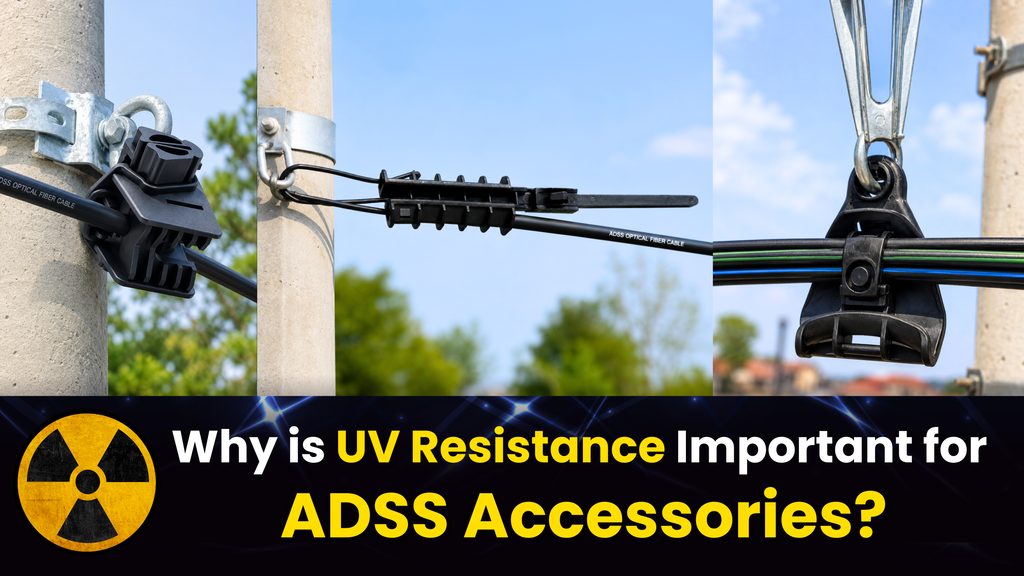
An ADSS cable can spend decades outdoors, exposed to sunlight, rain, wind, temperature changes and other environmental conditions. But when engineers and procurement teams evaluate an ADSS installation, one question is often overlooked:
What happens to the accessories supporting that cable after years of UV exposure?
ADSS accessories; including anchor clamps, suspension clamps, pole brackets, storage brackets and other fittings—are not simply installation hardware. They form part of the mechanical support system that keeps the aerial fiber cable securely positioned.
For utilities, telecom operators, EPC contractors and infrastructure companies, selecting accessories with suitable UV resistance can therefore be an important part of long-term project planning.
IEC 60794-4-20, which covers ADSS optical cables installed along electrical power lines, includes environmental considerations and compatibility with accessories. The standard also specifies UV-stabilized, weather-resistant material for the cable outer sheath.
Here are 7 important reasons UV resistance deserves attention when selecting outdoor ADSS accessories.
1. Continuous Sunlight Can Affect Polymer Materials
Outdoor ADSS accessories frequently contain polymeric components. These materials are exposed to ultraviolet radiation throughout their service life.
Over time, unsuitable materials may experience changes in surface appearance and material properties. Depending on the polymer and exposure conditions, prolonged UV exposure can contribute to degradation.
This is why simply asking for a “plastic clamp” is not enough.
B2B buyers should ask the manufacturer:
- What polymer is being used?
- Is it UV stabilized?
- What environmental testing has been performed?
- Is the material intended for prolonged outdoor installation?
The objective is not merely to select a strong component on day one, but a component designed for its intended outdoor environment.
2. UV Degradation Can Affect Long-Term Mechanical Performance
ADSS accessories are responsible for supporting or anchoring a cable under real-world mechanical conditions.
An accessory may experience cable tension, wind loading, temperature changes and other environmental stresses throughout its service life. If a polymer component loses important mechanical properties because of prolonged environmental exposure, its long-term performance may be affected.
This makes material selection particularly important for components such as:
- Anchor clamps
- Suspension clamps
- Wedges
- Cable supports
- Pole brackets containing polymer components
The key B2B question is therefore not simply:
“Does the product work during installation?”
It is:
“Is the material appropriate for long-term outdoor service?”
3. UV Resistance Helps Support Consistent Outdoor Performance
Outdoor telecom infrastructure is rarely installed in a controlled environment.
An ADSS route can pass through open fields, urban areas, industrial zones and other locations where sunlight and weather exposure vary considerably.
Published ADSS cable specifications commonly identify UV resistance as an environmental requirement. For example, one current ADSS product specification identifies UV resistance and references ISO 4892-2 testing for UV protection.
For project procurement teams, this illustrates an important principle:
Environmental performance should be specified, not assumed.
When comparing two accessories that appear identical, the difference may be hidden in the material formulation and testing rather than the external appearance.
4. UV Resistance Is Particularly Important for Polymer Clamps and Wedges
Some ADSS accessories use polymer bodies or wedges because they need to provide cable support while maintaining suitable dielectric and mechanical characteristics.
The polymer component is therefore not merely a cosmetic part of the product.
For example, an ADSS anchoring system may use a polymer wedge to grip the cable while transferring mechanical load through the accessory. A suspension system may similarly use polymer components to support the cable.
If your project involves such components, the procurement specification should clearly address outdoor suitability and UV resistance.
A good ADSS accessories manufacturer should be able to explain the material used, its intended application and the relevant quality or environmental testing.
5. UV Resistance Should Be Considered Alongside Other Environmental Factors
One common procurement mistake is treating UV resistance as the only environmental requirement.
Outdoor ADSS installations can face several conditions simultaneously:
- UV radiation
- Rain and moisture
- High and low temperatures
- Wind
- Dust and pollution
- Mechanical loading
- Electrical-field exposure on power-line routes
IEC 60794-4-20 specifically recognizes environmental considerations for ADSS installations on electrical power lines, including tracking and erosion considerations under certain conditions.
Therefore, a procurement specification should evaluate the complete environmental application, rather than choosing a product simply because it is labelled “UV resistant.”
6. Don’t Apply AB Cable Accessories Specifications Directly to ADSS
ADSS and AB cable systems serve different applications, so their accessories should not automatically be treated as interchangeable.
AB cable accessories are generally associated with aerial bundled electrical distribution systems, while ADSS accessories are designed around self-supporting optical fibre cables.
The broader procurement category may include products for overhead infrastructure, but the technical requirements are different.
This distinction is particularly important for companies purchasing both telecom and electrical distribution products, including HT LT line material.
A supplier may offer both product categories, but each accessory should still be evaluated against the cable type, application, loading conditions and applicable specifications.
7. Choose a Manufacturer That Can Prove Material and Product Quality
UV resistance should ultimately be supported by technical information—not just a statement in a quotation.
When evaluating an AB cable accessories manufacturer, ADSS accessories manufacturer or multi-product infrastructure supplier, ask for:
- Product datasheets
- Material specifications
- UV/environmental test information
- Mechanical test reports
- Applicable standards
- Cable-size range
- Installation instructions
- Quality-control documentation
- Sample approval
If you are searching for an AB cable accessories manufacturer in Delhi, location can be useful for communication, inspection and supply coordination. However, technical capability and documentation should remain important parts of supplier evaluation.
A manufacturer capable of supplying both electrical distribution products and telecom accessories should be able to clearly distinguish the requirements of each application.
What Should B2B Buyers Ask Before Ordering ADSS Accessories?
Before approving a bulk purchase, ask these questions:
- Is the polymer material suitable for prolonged outdoor exposure?
- Is UV stabilization specified by the manufacturer?
- Are relevant environmental or UV tests documented?
- Is the accessory compatible with the exact ADSS cable diameter and construction?
- Can the product handle the required mechanical loading?
- Are applicable technical standards and specifications available?
- Can the manufacturer provide consistent quality across bulk production?
Conclusion
UV resistance may not be the first specification that comes to mind when purchasing ADSS accessories, but for outdoor infrastructure, it deserves serious attention.
ADSS cables and their supporting accessories are expected to operate in environments where sunlight, weather and mechanical loading can continue for years. Selecting materials and products designed for the intended outdoor application can help project teams manage long-term reliability requirements more effectively.
For utilities, telecom operators, EPC contractors and distributors, the goal should not simply be to find the cheapest clamp or bracket.
The better procurement question is:
“Is this accessory designed for the environment in which our ADSS cable will actually operate?”
That question can lead to better technical evaluation, better supplier selection and more informed B2B procurement decisions.